Oslo Municipality
How a pump upgrade reduced energy consumption and delivered a short payback period
Does an old pump need to be replaced to reduce energy consumption?
Not necessarily.
For Oslo Municipality, an analysis of a pumping station showed that 29-year-old pumps were still performing well, but that it was possible to reduce energy consumption through a targeted upgrade.
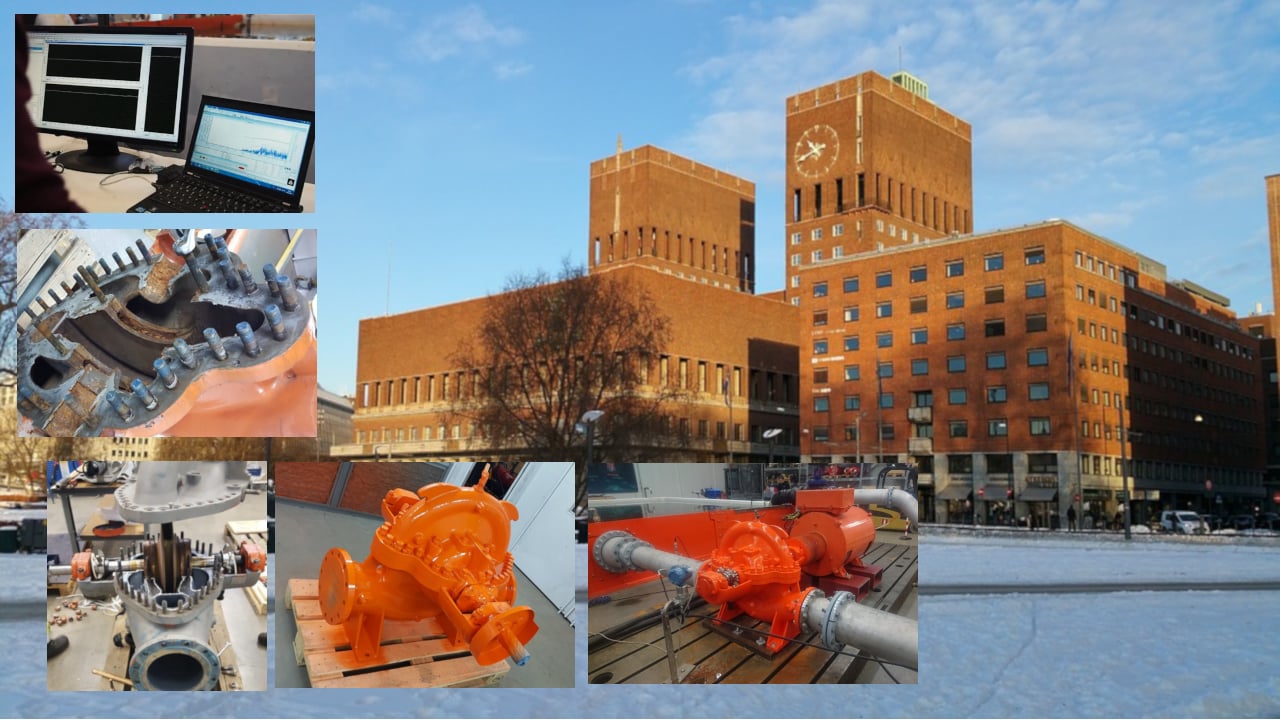
Fuglesangs removed one of the pumps, overhauled it and applied a Chesterton ARC low-friction coating. The results were measured and logged at Fuglesangs’ test facility.
The measurements showed that the investment in the upgrade could pay for itself in just 10 months, based on the energy price used in the project.
Following the positive results, the remaining three pumps were also overhauled. In total, the upgrade resulted in energy savings worth more than NOK 750,000 in 2021. This is an annual saving, and with today’s energy costs, the annual financial benefit has increased.
Project overview
Customer
Oslo Municipality
Facility
Pumping station in Oslo Municipality’s drinking water network
Equipment
Existing pumps
Starting point
The pumps were 29 years old
Measures
Overhaul and application of Chesterton ARC low-friction coating
Testing
Measurement and logging before and after the upgrade
Payback period
10 months
Energy savings
More than NOK 750,000 in 2021
The challenge: High energy consumption from existing pumps
Pumps used in water supply systems can have a long service life. However, even if a pump is still operating satisfactorily, this does not necessarily mean that it is performing optimally in terms of energy consumption.
Oslo Municipality’s own experience showed that the pumping station was operating well, even though the pumps were 29 years old.
At the same time, analyses and assessments by Fuglesangs indicated that it could be possible to improve the pumps’ energy efficiency without replacing the entire pumps.
This raised an important question:
Can existing pumps be upgraded instead of replaced?
The solution: A targeted upgrade of the existing pump
Fuglesangs proposed removing one of the pumps for a controlled upgrade.
The pump was overhauled and Chesterton ARC, a low-friction coating, was applied to the pump’s internal surfaces.
The objective was to reduce hydraulic losses within the pump and thereby reduce the energy required to deliver the necessary performance.
An important aspect of the project was that the effect was not simply assumed.
It was measured.
Performance before and after the upgrade was measured and logged at Fuglesangs’ test facility.
The result: The investment paid for itself in 10 months
Based on an energy price of NOK 0.70/kWh, the measurements showed that the cost of the upgrade could be recovered in just 10 months.
This provided Oslo Municipality with a concrete basis for its investment decision.
Rather than basing a potential upgrade on assumptions, the municipality was able to evaluate the actual results from the first pump.
The results led to the remaining three pumps also being overhauled.
More than NOK 750,000 in energy savings
After all four pumps had been overhauled, Fuglesangs reported total energy savings for the pumping station worth more than NOK 750,000 in 2021.
The upgrade also provided other benefits. According to Fuglesangs, this type of treatment can improve wear resistance and pump reliability.
The project therefore demonstrates that significant energy savings do not necessarily require the complete replacement of existing pumping equipment.
Why measure before investing?
When a pump has been in operation for many years, it can be difficult to determine how much its efficiency can actually be improved.
Testing can therefore be an important part of the decision-making process.
In this project, one pump was used to document the effect of the proposed measures before a decision was made regarding the remaining pumps.
The process can be described as follows:
Existing pump → overhaul → upgrade → testing → documented results → decision on the rest of the installation
This approach reduces the need to base an investment solely on theoretical calculations.
When should you consider upgrading an existing pump?
It may be worth investigating the energy efficiency of existing pumps when:
- the pumps have been in operation for many years
- energy consumption represents a significant share of operating costs
- the pumps are still in good mechanical condition
- maintenance or overhaul is feasible
- there is a desire to extend the service life of existing equipment
- complete replacement would be costly or difficult
- documented evidence of potential energy savings is required before making a larger investment
However, not all old pumps should be upgraded. Their condition, operating point, hydraulics, energy consumption and the cost of the proposed measures should all be assessed before deciding whether a pump should be repaired, upgraded or replaced.
Energy optimisation is about more than the pump itself
A pump’s energy consumption is influenced by the entire system in which it operates.
An energy-efficiency analysis should therefore consider factors including:
- the pump’s operating point
- flow rate and head
- hydraulic losses
- pump efficiency
- internal wear
- internal pump surfaces
- motor and drive system
- valves and piping
- actual pump operating hours
- variations in load
By considering the entire system, it is possible to identify where energy losses actually occur.
From cost to investment
The Oslo Municipality project illustrates the difference between maintenance and targeted energy optimisation.
An overhaul may initially be considered a necessary maintenance measure.
However, when the same measure also reduces energy consumption, the investment can have a very different financial impact.
In this project, the energy savings were significant enough for the first upgrade to have an estimated payback period of just 10 months.
This made it possible to use the results from one pump as the basis for deciding whether to upgrade the rest of the pumping station.
Fuglesangs’ approach to energy optimisation
Fuglesangs works with energy optimisation of existing pumping systems through measures including testing, overhaul and treatment of internal pump surfaces.
Energy optimisation is also part of Fuglesangs’ work to improve customers’ overall operating economics, uptime and the service life of existing equipment.
The objective is not necessarily to sell a new pump.
In some cases, the most cost-effective solution may be to improve the pump the customer already has.
What can other pumping station owners learn from this project?
The Oslo Municipality case demonstrates that it can be worthwhile to assess existing pumping equipment before deciding on complete replacement.
A systematic process could include:
- Assess the existing pumps
- Measure actual energy consumption and performance
- Evaluate the mechanical condition of the pumps
- Identify potential energy-efficiency measures
- Test the measures on one pump where appropriate
- Document the results
- Calculate the payback period
- Evaluate whether the measures should be implemented across the rest of the installation
This provides a stronger basis for prioritising investments.
Do you have older pumps with high energy consumption?
If your pumps are still operating well but energy costs are high, buying new pumps may not necessarily be the best solution.
Fuglesangs can assess whether your existing pumps can be tested, overhauled and energy-optimised, and whether an upgrade could deliver measurable financial savings.
Contact Fuglesangs to assess the potential of your existing pumps.